
Workday performance management can give managers and employees one place to set goals, exchange feedback, complete reviews, and connect performance discussions with development. The software does not decide what good performance looks like or how your organization should evaluate it. Your operating model does.
Teams get more value from Workday when they settle the hard questions before configuration: who owns the process, which decisions reviews support, what evidence managers should use, and how leaders will check for inconsistent ratings. This guide explains the design choices that shape a useful process and a stable Workday configuration.

What Workday performance management should accomplish
A sound process gives employees clear expectations and gives managers enough structure to make fair, useful decisions. Workday can support that process through goal management, feedback, performance reviews, calibration, and development data. Workday describes performance enablement, feedback, goals, recognition, and talent visibility as connected parts of its Talent Optimization capabilities.
Your licensed products and tenant configuration determine which features you can use. Start with the employee and manager experience you want, then confirm how Workday should support it.
A practical target state includes:
- Employees can see their goals, expectations, and review dates.
- Managers know when to check in and what evidence to document.
- HR can compare ratings without forcing artificial distributions.
- Leaders can connect performance decisions with development, compensation, and workforce plans.
- Process owners can monitor completion, quality, exceptions, and access.
Eight decisions to make before configuration
1. Define the purpose of the process
Decide which business decisions the process must support. A review used for coaching needs a different structure from one that also informs pay, promotion, succession, or formal performance action. Combining every decision in one form can make employees guarded and managers vague.
Write a short purpose statement and test each proposed field against it. If a question will not support a decision or conversation, remove it. This keeps the form focused and reduces review fatigue.
2. Design a goal architecture people can use
Workday performance management works best when goals have clear ownership, timeframes, and measures. Decide whether goals cascade from company priorities, connect across teams, or remain specific to an employee's role. Define who can create, edit, approve, and close a goal.
Avoid turning every activity into a goal. A small set of outcome-based goals gives managers a stronger basis for coaching and review. Leave room for priorities to change, but require a reason and an audit trail when a material goal changes during the cycle.
3. Set the check-in cadence and responsibilities
Choose a cadence that fits the work. Monthly check-ins may suit fast-moving teams, while quarterly conversations may work for roles with longer delivery cycles. The calendar matters less than consistent use.
Define what the employee prepares, what the manager records, and when HR follows up. Keep routine check-ins short. Managers should discuss progress, obstacles, support, and next actions instead of repeating the full review form throughout the year.
4. Build rating rules around evidence
Each rating needs a plain-language definition and examples tied to job performance. Managers should understand the difference between results, behaviors, skills, and potential. Mixing those concepts creates ratings that employees cannot interpret and HR cannot compare.
Require factual support for high and low ratings. Evidence can include goal results, work samples, customer outcomes, documented feedback, or role-specific measures. Do not reward the longest narrative. Reward a clear connection between the standard, the evidence, and the rating.
5. Decide how calibration will work
Calibration should help leaders compare how teams applied the same standards. It should not become a meeting where executives trade names until a target distribution appears.
Set the participants, data views, decision rights, and documentation rules before the first session. Give facilitators a way to challenge unsupported changes. Record the reason for a rating change so HR can review patterns and managers can explain the final decision.
6. Separate development from the rating discussion
Employees need room to discuss skills, career interests, and development needs without treating every gap as a performance failure. Connect review outcomes with development planning, but give the development conversation its own questions and follow-up actions.
Workday can bring performance, skills, and career data into a shared talent view. The Workday Talent Optimization datasheet lists goal management, performance enablement, skills management, career development planning, and talent visibility among its core features. Your governance should define who may see and use each type of data.
7. Set security, privacy, and retention rules
Performance records can influence pay, promotion, succession, and employment action. Map access by role and process stage. Managers may need access to current direct reports, while HR partners and calibration leaders need broader views for specific purposes.
Document how long the organization retains review records, who can correct an error, and how employees raise a concern. Test proxy, delegated, terminated-worker, transfer, and matrix-manager scenarios. A clean happy-path test will not expose the access problems that appear after an organizational change.
8. Choose measures and an owner for ongoing governance
Name a process owner who can make decisions after launch. That owner should review adoption, exceptions, rating patterns, user feedback, and Workday release impacts. HR, legal, compensation, talent, and HRIS teams may contribute, but one person or forum needs clear authority.
Measure whether the process improves decisions and conversations. Completion rate alone cannot tell you whether reviews were useful, fair, or on time.
A practical implementation sequence
Configure after the design team agrees on the process. A controlled sequence reduces rework and gives testers a clear basis for acceptance.
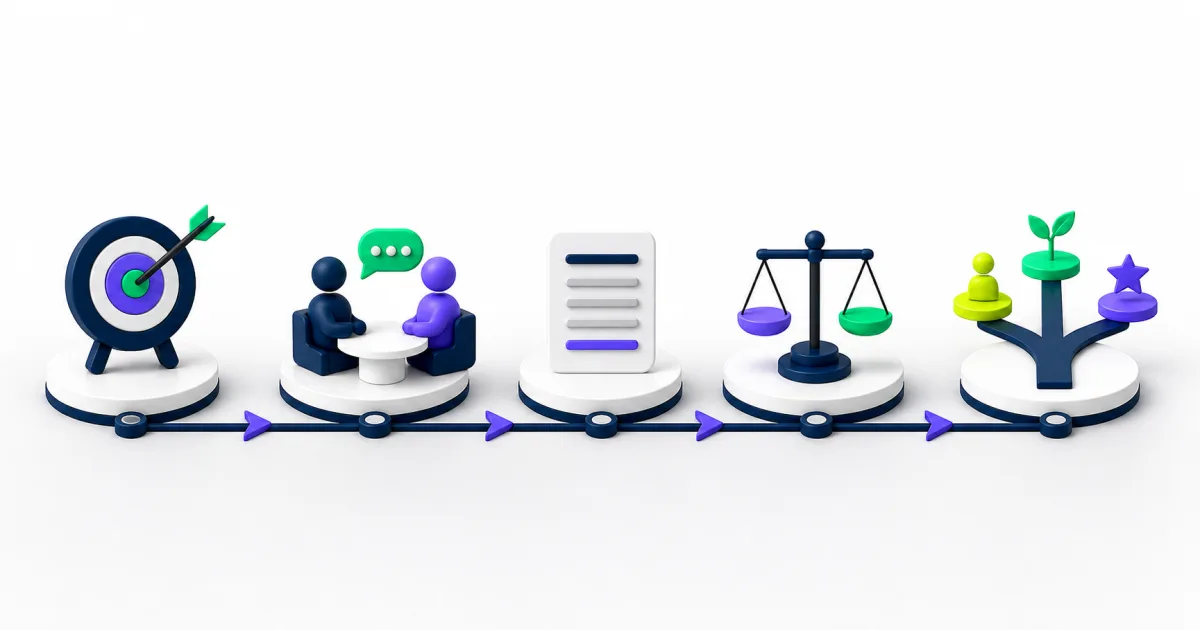
- Document the purpose, scope, owners, decision rights, and review calendar.
- Map the employee, manager, HR, and calibration journeys.
- Define goals, sections, rating scales, instructions, and validations.
- Configure security, notifications, approvals, and business-process routing.
- Build reports for completion, exceptions, rating patterns, and access review.
- Test with realistic worker populations, transfers, leaves, manager changes, and late reviews.
- Pilot with a representative business group before broad launch.
- Train managers with examples drawn from the roles they supervise.
Build fairness into the operating process
Software can enforce steps, but managers still interpret evidence and apply standards. The U.S. Equal Employment Opportunity Commission advises employers to communicate performance standards, apply them consistently, explain whether an employee met them, and include relevant facts in evaluations. Its performance evaluation guidance also warns against holding employees to different standards because of protected characteristics.
Turn those principles into controls:
- Publish standards before the review period begins.
- Train managers to distinguish job results from style preferences.
- Ask for evidence when a rating sits far above or below the expected range.
- Compare rating patterns by manager, business unit, and relevant employee groups.
- Give employees a clear route to question factual errors.
- Review calibration changes and the reasons recorded for them.
Organizations should involve employment counsel when they design evaluation policies or use performance data for high-consequence decisions. Workday configuration supports the process, but it does not replace legal review or accountable management.
Prepare managers for the conversations
Managers determine whether employees experience the process as useful or bureaucratic. A system demonstration will teach them where to click. It will not teach them how to set a measurable goal, discuss missed expectations, or write evidence that another reviewer can understand.
Manager enablement should include practice. Give managers sample goals, weak and strong review comments, calibration scenarios, and a short guide to difficult conversations. Show them how the process connects with compensation and talent decisions without promising an outcome the review does not guarantee.
Support does not end at launch. Office hours, completion reports, and targeted follow-up help HR address problems before a deadline. Teams that need ongoing configuration, reporting, and release support can connect this process with an enterprise managed services model.
Measure whether the process works
Use a small set of measures that covers execution, quality, fairness, and employee experience:
- On-time completion: reviews finished by the deadline, with overdue work split by business unit and manager.
- Check-in adoption: employees receiving the expected conversations during the cycle.
- Evidence quality: reviews that include specific examples tied to agreed standards.
- Rating movement: changes made during calibration, including the documented reason.
- Distribution patterns: differences by manager, function, location, and relevant employee groups.
- Employee confidence: survey responses on clarity, usefulness, and perceived consistency.
- Development follow-through: agreed actions that receive an owner, due date, and later update.
- Process effort: time spent completing forms, resolving errors, and handling exceptions.
Review the measures after each cycle and make a short list of changes. Large annual redesigns create retraining and reporting work. Smaller changes are easier to test and explain.
Common failure patterns
The form is longer than the conversation
Remove questions that do not support a decision. Keep instructions close to the field they explain. Use reporting for oversight instead of adding more prompts to every employee's form.
Goals go stale after launch
Assign goal owners and set dates for review. Let employees propose changes, then route material changes to the right approver. Closed or replaced goals should remain understandable in the record.
Calibration changes lack an explanation
Require a reason for material changes and give HR a report that shows who changed what. This creates a better record for employee conversations and process review.
Reporting starts after the first cycle
Design reports during configuration. Test security and totals with the same worker scenarios used for the business process. If leaders cannot see completion, exceptions, and rating patterns, they cannot govern the cycle.
Frequently asked questions
What is Workday performance management?
Workday performance management refers to the processes and configuration used to manage goals, feedback, reviews, calibration, and related development information in Workday. Available features depend on the organization's Workday products and tenant setup.
Does Workday replace manager judgment?
No. Workday can guide steps, capture evidence, enforce routing, and support reporting. Managers and process owners remain responsible for standards, conversations, ratings, and decisions.
How often should performance check-ins occur?
The right cadence depends on the work, manager capacity, and decision cycle. Many organizations use monthly or quarterly check-ins. Consistency and conversation quality matter more than adding frequent tasks that managers treat as a formality.
How long does implementation take?
Timing depends on process scope, stakeholder alignment, integrations, security, reporting, testing, and change readiness. A focused configuration may take less time than a redesign that also changes goals, ratings, compensation links, and talent processes. EVOCS uses a structured enterprise implementation approach that covers discovery, configuration, validation, enablement, launch, and stabilization.
Design the process before you build it
A useful Workday performance management process gives employees clear expectations, helps managers make evidence-based decisions, and gives HR enough visibility to address inconsistency. That outcome depends on process design, governance, testing, and manager preparation.
EVOCS helps organizations design, configure, test, and improve Workday processes with senior practitioners who stay close to the work. If your review cycle has become difficult to manage or your current configuration no longer fits the business, schedule a strategy conversation. We will help you define the problem and tell you where we can add value.