
How to select an HRIS provider starts with a written view of the outcomes, data, integrations, risks, and service levels your organization needs. An HRIS centralizes employee information and core HR processes, so the choice affects payroll, reporting, security, compliance, and the employee experience.
A strong selection process gives each vendor the same scenarios and scoring rules. HR, payroll, finance, IT, security, legal, and business leaders can then compare evidence instead of reacting to a polished demo. The nine steps below turn that work into a decision your team can defend and implement.
How to Select an HRIS Provider in Nine Steps
Use one decision log throughout the process. Record requirements, assumptions, vendor answers, risks, costs, and owners. This prevents late-stage changes from disappearing into email threads and gives the implementation team a reliable starting point.
1. Define Business Outcomes and Success Measures
Start with the problems leaders expect the new system to solve. A feature inventory cannot tell you whether payroll closes faster, managers complete approvals, or HR produces trusted workforce reports. Assign an owner and a measure to each outcome.
- Reduce manual payroll adjustments and reconciliation work
- Give managers one place for approvals and employee changes
- Improve workforce reporting accuracy and delivery time
- Support planned growth, acquisitions, or new countries
Separate launch requirements from later phases. The distinction protects the first release from unnecessary scope and makes vendor estimates easier to compare.
2. Map Processes, Data, and Requirements
Document how work moves today, where employees or administrators re-enter data, and which spreadsheets compensate for system gaps. Review employee records, payroll inputs, benefits, time, recruiting, onboarding, performance, learning, and reporting. Include regional rules and collective agreements where they apply.
Write requirements as testable statements. For example, replace "supports integrations" with "sends approved worker and cost-center changes to the ERP each night, records failures, and alerts the integration owner." Mark each requirement as required for launch, planned for a later phase, or optional. This evidence helps leaders decide how to select an HRIS provider without relying on feature lists.
3. Set the Buying Team and Decision Rights
Name an executive sponsor, process owners, technical reviewers, security and privacy reviewers, procurement, and a final decision owner. Employee and manager representatives should test common tasks. Define who can change scope, approve exceptions, and accept risk before vendor meetings begin.
Use a small working team to manage the evaluation and bring specialists into the sessions where their evidence matters. Payroll should validate pay-cycle scenarios. Security should review identity, access, logging, incident response, and vendor controls.
4. Screen Security, Privacy, and Supplier Risk
Security evidence belongs in any process for how to select an HRIS provider because HR systems hold identity, compensation, bank, benefits, performance, and leave data. Ask vendors to explain data locations, encryption, tenant isolation, privileged access, audit logs, retention, deletion, subprocessors, breach notification, backups, recovery tests, and vulnerability management.
CISA's Secure by Demand guidance recommends placing product security questions into procurement and contract discussions. The NIST supplier due-diligence guide provides a current framework for assessing ownership, provenance, resilience, foundational cyber practices, and supply-chain tiers. Adapt those questions to the sensitivity of your HR data and the laws that apply to your organization.
Connect this review to your broader HR data security controls. Record open risks, the vendor's evidence, the person accepting each exception, and any required contract language.
5. Build a Shortlist Based on Fit
Use the launch requirements, operating model, workforce size, countries, payroll approach, internal support capacity, and budget range to create a shortlist. Eliminate products that miss a mandatory requirement or depend on an unapproved workaround.
Request written answers before scheduling long demos. Ask vendors to identify configuration limits, third-party dependencies, regional gaps, product-roadmap items, and assumptions behind their estimates. A roadmap promise should not receive the same score as a feature available for testing.
6. Run Scripted Demos with Real Scenarios
A scripted demo gives teams deciding how to select an HRIS provider comparable evidence. Give each vendor the same scripts and sample roles. Ask the vendor to show the work in the product instead of presenting slides. Include a new hire, manager transfer, compensation change, leave request, payroll correction, security-role change, failed integration, and workforce report.
- Record the number of steps and handoffs
- Note configuration, custom work, and third-party tools
- Test employee, manager, administrator, and auditor views
- Capture unanswered questions with owners and due dates
Score the evidence after each session. Waiting until the end lets presentation quality outweigh product fit.
7. Validate Integrations and Data Migration
Inventory every system that sends or receives worker, payroll, finance, identity, benefits, recruiting, learning, and time data. For each connection, document direction, frequency, volumes, authentication, monitoring, error handling, data ownership, and support responsibility.
Ask vendors to profile sample legacy data and explain conversion tools, validation reports, reconciliation, history limits, document migration, and cutover support. A credible estimate identifies source systems, transformation rules, test cycles, and client responsibilities.
8. Compare Total Cost and Contract Terms
Compare costs over the same period and scope. Include subscriptions, implementation, integrations, conversion, testing, training, change support, partner services, internal labor, premium support, environments, and planned expansion. Model price changes tied to employee counts, modules, transactions, storage, and renewal terms.
Review service levels, data-export rights, deletion duties, subprocessor changes, audit evidence, breach notification, liability, termination assistance, and renewal notice dates. Tie material promises from the sales process to the contract or statement of work.
9. Evaluate Implementation and Ongoing Support
The product decision and delivery plan belong in the same evaluation. Confirm the implementation method, named roles, estimated client effort, design governance, testing cycles, training, cutover, stabilization, and post-launch support. Meet the proposed delivery leaders before signing when the provider allows it.
Call references that resemble your organization in size, industry, geography, modules, and integration complexity. Ask what changed after contracting, where the client supplied more effort than expected, how the vendor handled defects, and whether support met the promised response times.
Use a Weighted HRIS Vendor Scorecard
A scorecard helps leaders answer how to select an HRIS provider with consistent evidence, but the weights must reflect your priorities. Set the weights before demos and require reviewers to explain low or high scores. One practical starting model is:
- Functional and regulatory fit: 25%
- Employee, manager, and administrator experience: 15%
- Integrations, reporting, and data migration: 15%
- Security, privacy, resilience, and supplier risk: 15%
- Implementation approach and ongoing support: 15%
- Total cost and contract terms: 15%
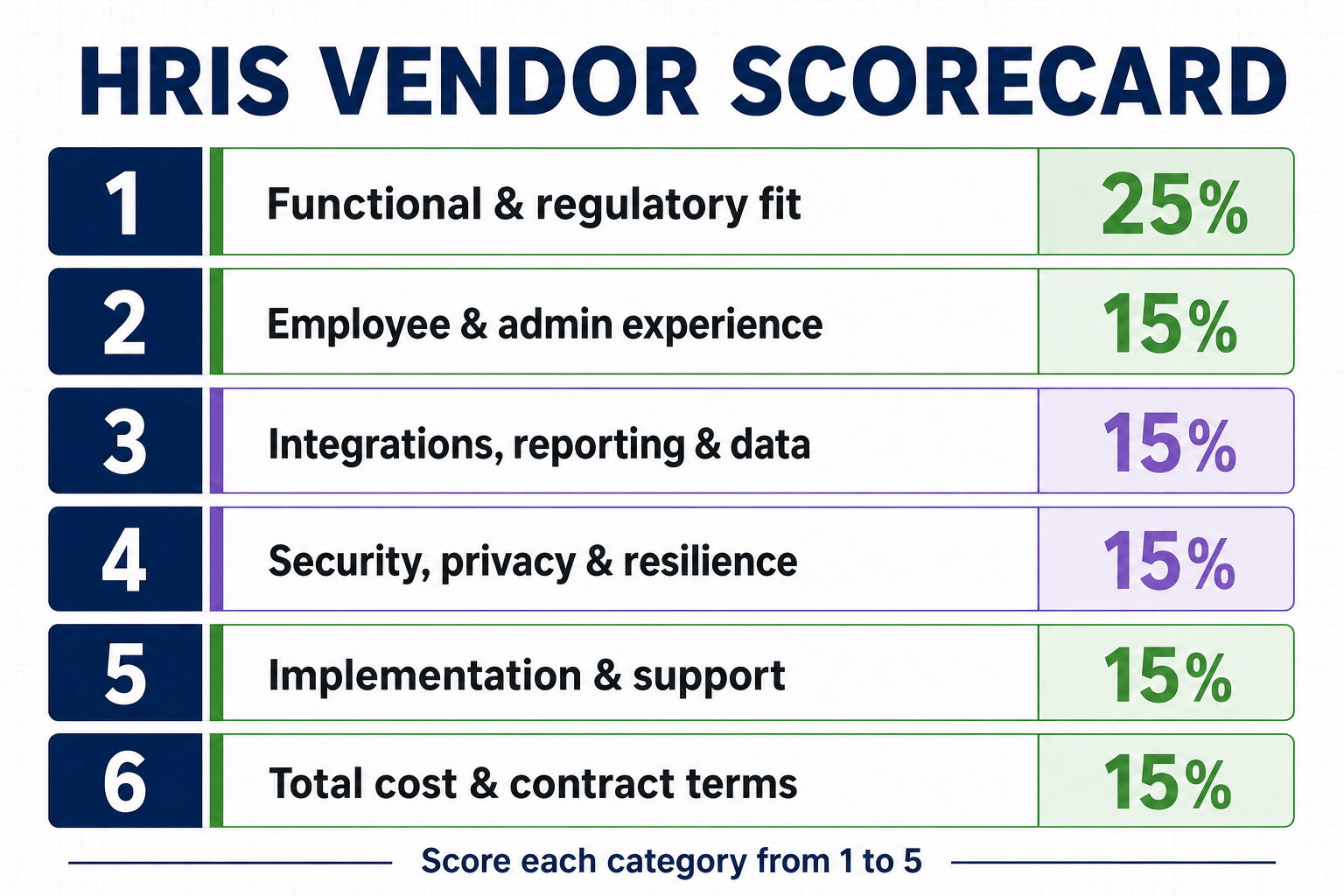
Keep mandatory requirements outside the weighted total. A vendor should not offset a failed payroll, security, or regulatory requirement with a strong score in another category. Run a sensitivity check to see whether small weight changes alter the winner.
Watch for HRIS Selection Red Flags
The selection team should pause when a vendor avoids a scripted scenario, treats a required feature as a future roadmap item, cannot explain integration monitoring, or gives vague security answers. Pricing that excludes conversion, environments, support tiers, or common integrations also needs clarification.
Reference calls should match the proposed product and delivery model. Investigate major differences between the sales team's promises, the implementation scope, and the support contract before you approve the purchase.
Independent Guidance for HRIS Provider Selection
Teams working out how to select an HRIS provider can use an independent advisor to organize requirements, moderate demos, challenge estimates, and keep vendor scoring consistent. EVOCS supports HR technology advisory, vendor evaluation, implementation planning, data and integration reviews, and operating-model decisions across major HR platforms.
The engagement should leave your team with reusable requirements, a decision log, a risk register, a cost model, and an implementation-ready scope. Contact EVOCS to review your shortlist or build the selection process from the start.
HRIS Provider Selection FAQs
How many HRIS providers should we evaluate?
Screen the market against mandatory requirements, then invite a small shortlist to the detailed evaluation. Three or four qualified vendors often give a team enough comparison without creating duplicate work, though complex global requirements may justify more.
How long does HRIS selection take?
The timeline depends on scope, countries, payroll, integrations, governance, and procurement rules. Build the schedule around requirements, security review, scripted demos, references, contract negotiation, and executive approval instead of choosing a date first.
Should price determine the winning HRIS provider?
Price belongs in the decision, but teams should compare total cost and risk across the same scope. A low subscription estimate can hide conversion work, integration tools, premium support, internal labor, or contract increases.
Should we choose the software and implementation partner together?
Evaluate the delivery model before signing the software agreement. The implementation approach can change cost, timeline, design quality, testing, and the support your team needs after launch.
What evidence should an HRIS provider supply?
Request scripted product demonstrations, written requirement responses, security and privacy evidence, architecture details, implementation assumptions, pricing schedules, service levels, contract terms, and relevant customer references.