
HR and finance integration connects workforce decisions to budgets, forecasts, controls, and financial results. Hiring plans, compensation changes, reorganizations, and contingent labor commitments all affect cost. Finance cannot model those effects accurately when HR data arrives late or uses different definitions.
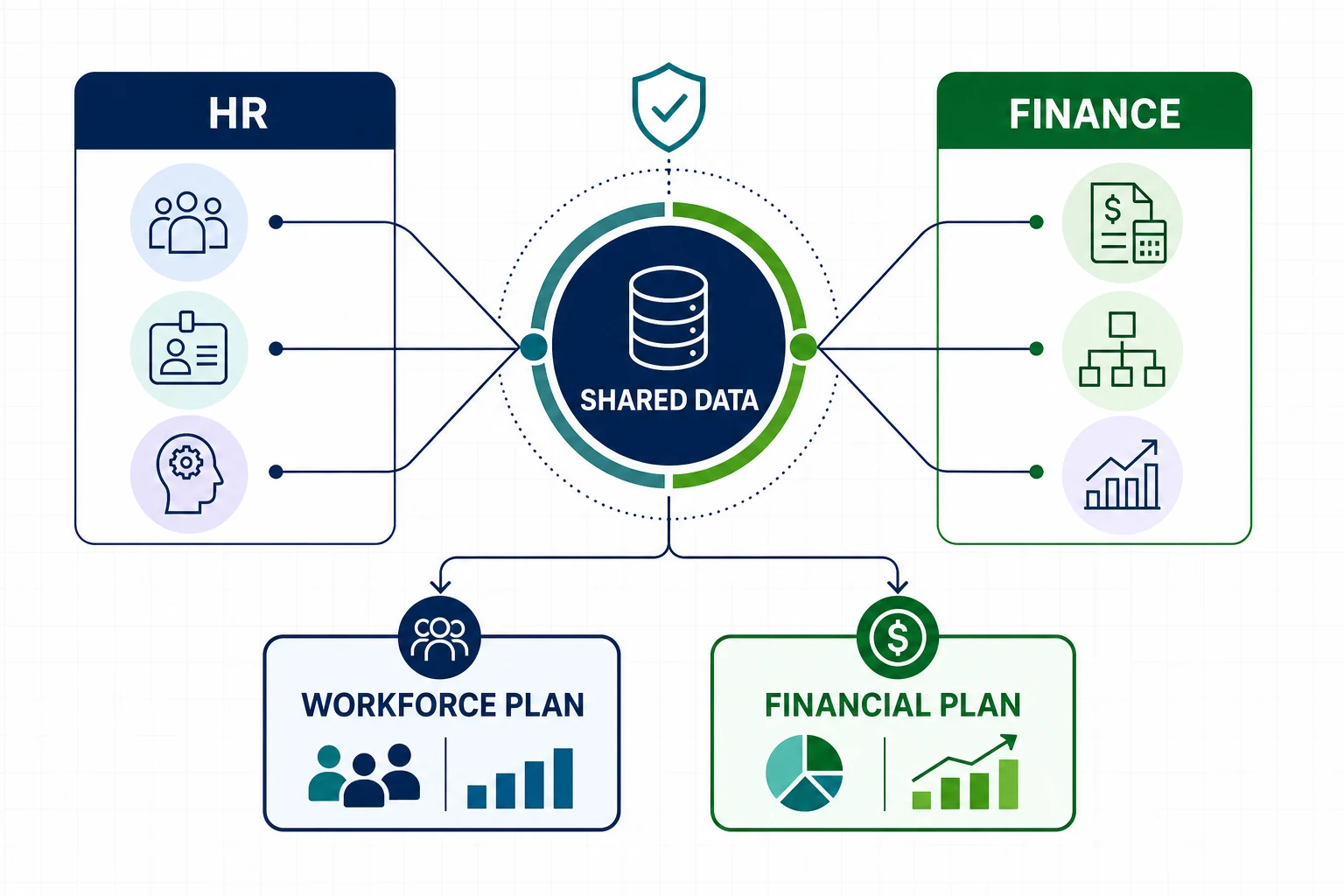
The work extends beyond moving files between systems. Teams need shared dimensions, clear ownership, synchronized calendars, and controls for sensitive employee data. These seven steps create a practical operating model.
Why HR and Finance Need Shared Data
HR may organize work by supervisory structure, position, worker, location, and job profile. Finance may use company, cost center, ledger account, project, and spend category. HR and finance integration maps those views so leaders can connect headcount, labor cost, capacity, and business performance.
Workday documents that Adaptive Planning can use HCM and financial data for headcount and financial planning, then publish approved plans back to Workday applications. Review the official Adaptive Planning configuration overview when defining the target design.
1. Agree on Business Questions
Start with decisions that require both workforce and financial evidence. Examples include whether to open positions, shift work to another location, use contractors, reorganize a department, or revise a sales capacity plan.
- Which positions are funded and approved?
- How do hiring delays change the forecast?
- Which compensation changes exceed budget?
- Where do vacancies constrain revenue or service delivery?
2. Define Shared Dimensions and Terms
Create a crosswalk for companies, cost centers, locations, projects, positions, worker types, and time periods. Define headcount, full-time equivalent, vacancy, contractor, compensation, and labor cost so reports do not present competing totals.
Assign an owner to every shared definition. Record effective dates and mapping changes because reorganizations can alter both historical reporting and future plans.
3. Map Events and Integration Flows
Document each event that crosses the boundary between HR and finance. Hiring, transfers, terminations, compensation, time, expenses, procurement roles, and cost-center changes may update several systems. For each flow, record source, destination, frequency, controls, error handling, and reconciliation.
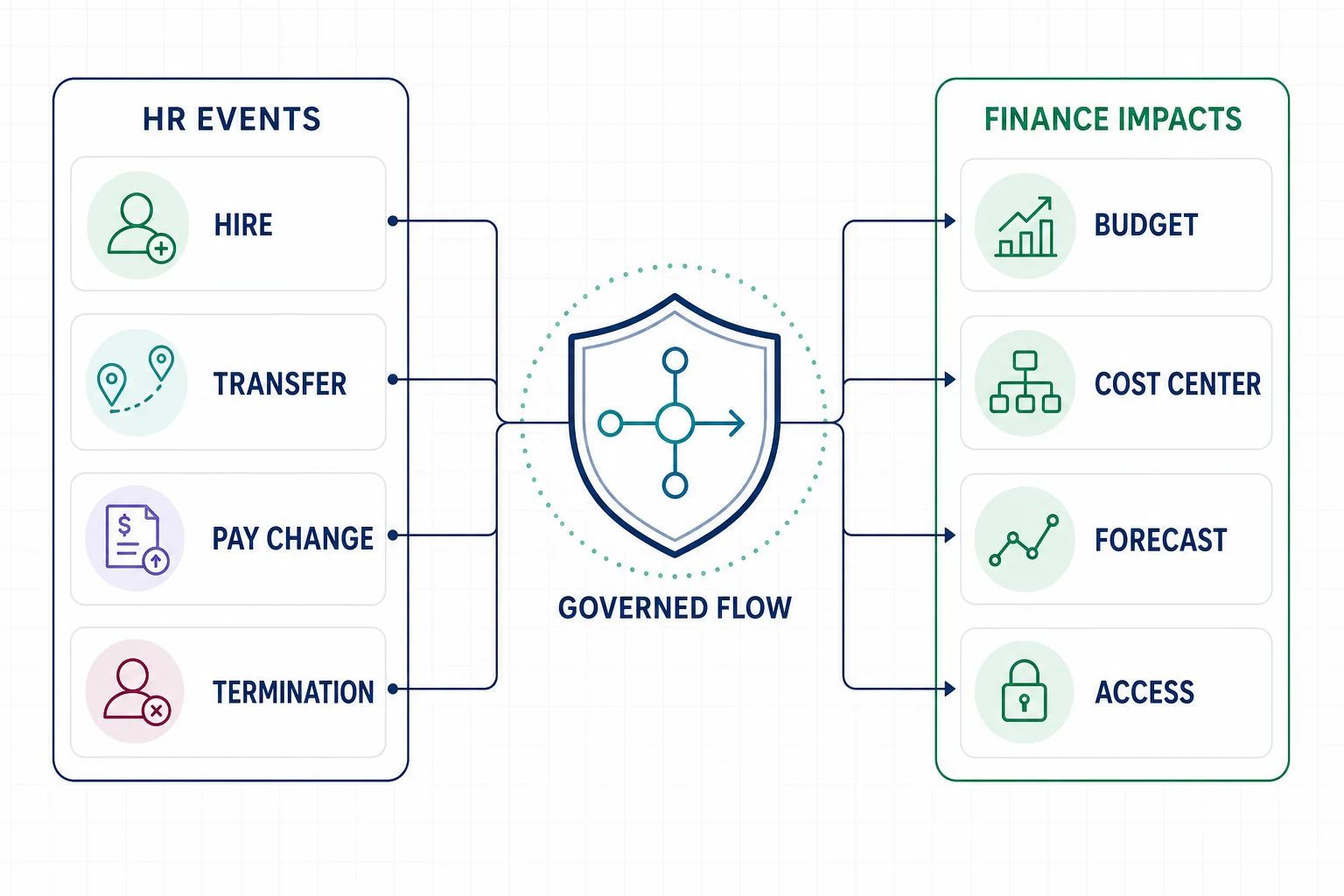
HR and finance integration should use approved events rather than unofficial spreadsheets. Monitor failures and give business owners a clear process for correcting source data.
4. Connect Workforce and Financial Planning
Align position plans, hiring dates, compensation assumptions, benefits, taxes, and contractor costs with the financial forecast. Give managers a controlled way to propose changes while HR and finance retain approval authority.
Workday describes connections between Adaptive Planning, HCM, and Financial Management for data, metadata, drill-through, and approved plans. Confirm licensed capabilities and implementation requirements before setting scope.
5. Coordinate Approvals and Controls
Define who can create, approve, change, and cancel a position or spending authority. Review segregation of duties when HR events trigger financial access, purchasing limits, cards, or accounting assignments. Sensitive compensation and personal data should follow least-privilege access.
Retain approval history, interface logs, and reconciliation evidence. These records support operational reviews and audits.
6. Build Cross-Functional Reporting
Design a small set of reports that join funded positions, active workers, vacancies, actual labor cost, forecast cost, and business drivers. Allow leaders to move from summary variance to the responsible organization without exposing unnecessary employee detail.
Use the same definitions in dashboards, board materials, and operating reviews. A shared report should replace duplicate spreadsheets rather than create another number to reconcile.
7. Govern the Operating Model
Create joint ownership across HR, finance, IT, payroll, procurement, and security. Review data quality, failed integrations, mapping changes, forecast variance, and planned organizational events on a fixed cadence.
HR and finance integration improves when teams treat definitions, controls, and decisions as ongoing products with named owners.
Choose the Right Integration Pattern
Use event-driven integration when an approved worker or position change must trigger prompt action in another system. Use scheduled batches when the process depends on a complete period or when source controls require reconciliation before transfer. APIs, packaged connectors, and files can all work when teams define authentication, monitoring, recovery, and ownership.
Avoid connecting every source directly to every destination. A clear architecture reduces duplicated mappings and inconsistent logic. Document which system owns each field, where transformations occur, and how support teams trace a failed record from source to destination.
Test effective-dated changes, retroactive corrections, terminations, rescinded events, reorganizations, and closed accounting periods. These cases often expose timing differences between HR and finance systems. Use representative records in a nonproduction environment, compare expected and actual results, and retain the evidence. Production monitoring should alert an owner before a missed event affects payroll, access, procurement, or the forecast. Include volume and performance tests when a payroll cycle, acquisition, or annual planning process creates unusually large files or transaction bursts.
Measure Integration Quality and Business Outcomes
Track technical measures such as successful loads, rejected records, recovery time, stale credentials, and reconciliation differences. Pair them with business measures: forecast cycle time, position approval time, labor-cost variance, duplicate entry, and hours spent reconciling reports.
Review the scorecard with HR and finance owners each month. Assign actions for repeated defects and remove measures that do not support a decision. HR and finance integration creates value when leaders receive consistent evidence in time to change a plan, approve a hire, or correct a control issue. Publish owners and due dates for every unresolved exception.
Create a quarterly roadmap that combines process changes, data remediation, integration work, reporting improvements, and access reviews. Estimate business value and control impact before assigning priority. This keeps the team from treating every interface request as an isolated technical task and gives executives a clear view of dependencies, investment, and expected results.
HR and Finance Integration FAQs
Which integration should come first?
Start with the decision that creates the most manual reconciliation or financial risk. Funded positions and labor-cost forecasting often provide a focused first scope.
Who owns shared workforce data?
Ownership should follow the source and business meaning. HR may own worker and position data while finance owns accounts and budgets, with joint governance for mappings.
How can EVOCS help?
EVOCS supports operating-model design, data mapping, planning, integrations, reporting, and controls. Contact EVOCS to assess HR and finance integration priorities.