
HR technology integrations create value when they move trusted data between systems at the right time, with clear ownership when something fails. A connection that works during a demonstration can still create payroll errors, delayed access, duplicate records, and reporting gaps after launch. The difference is the operating discipline around the connection.
This guide explains how HR, IT, payroll, finance, and security teams can choose the right integration approach, govern sensitive workforce data, test realistic scenarios, monitor production flows, and measure business value without relying on speculative ROI claims.
Start With the Business Event, Not the Connector
An integration exists to support a business event. A candidate accepts an offer. An employee starts work, changes location, takes leave, receives a compensation change, or leaves the company. Each event creates decisions and data that several systems may need.
Begin by documenting the event, its desired outcome, and the people affected. Then identify which system records the decision, which systems consume it, how quickly they need it, and what the team should do if the data is late or rejected. This sequence prevents a technical connection from becoming a substitute for an unclear process.
For every proposed flow, answer:
- What business event starts the flow?
- Which system is authoritative for each field?
- Who approves the underlying decision?
- Which downstream systems depend on the result?
- How quickly must the data arrive?
- Who resolves an exception?
- What evidence must the organization retain?
Map the HR Technology Ecosystem
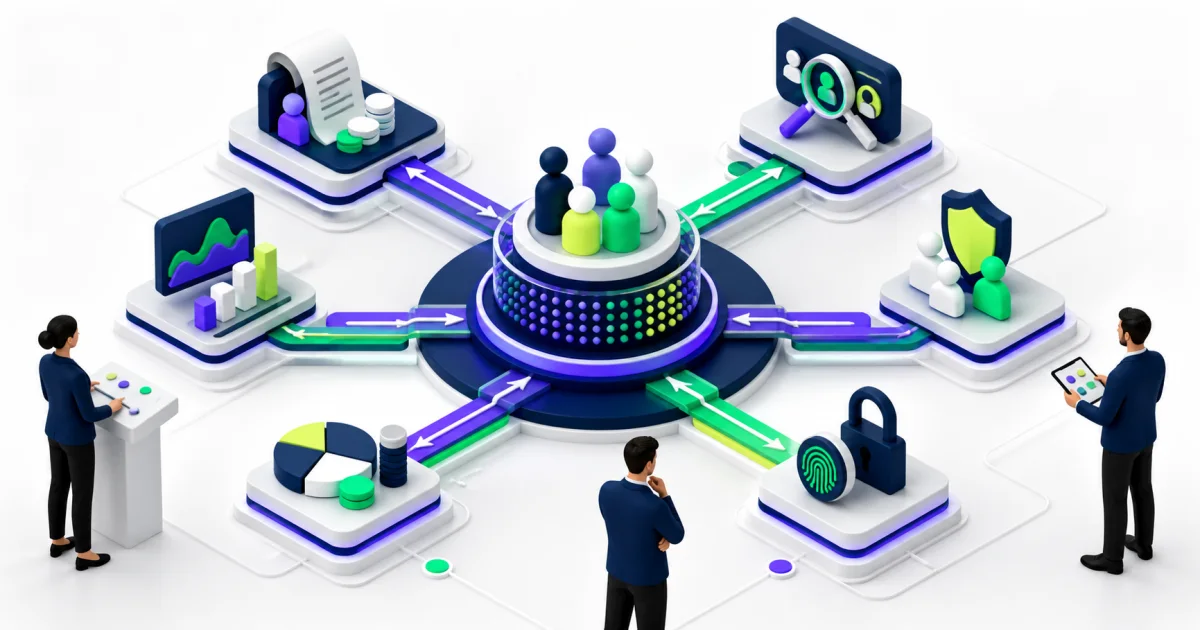
A useful architecture map shows more than application names. It records the direction of each flow, the data being exchanged, frequency, business owner, technical owner, security method, criticality, and downstream dependencies.
Most HR environments include several of these domains:
- Core HR or HRIS
- Recruiting and onboarding
- Payroll and time
- Benefits administration
- Identity and access management
- Learning and performance
- Finance and workforce planning
- Data platforms and analytics
- Document management and electronic signature
Mark every manual file, spreadsheet, and rekeying step. Those are integrations too, even when nobody calls them that. They often carry the highest control risk because ownership, validation, and history live in individual routines.
Define the System of Record for Each Data Element
Calling one platform the system of record is rarely precise enough. The HRIS may own legal name and employment status, while payroll owns tax elections and bank details. Recruiting may own candidate information until a hiring decision creates the worker record. Identity systems may own account state while HR owns the employment event that should trigger it.
Create a field-level ownership matrix for critical information. Include the source, permitted editors, validation rule, effective-date behavior, consumers, and correction process. Pay special attention to employee identifiers, manager relationships, company and cost-center assignments, work location, compensation, scheduled hours, leave status, and termination dates.
Decide how corrections travel. If payroll fixes a value that HR owns, the team needs a controlled way to correct the authoritative source and replay the downstream update. Otherwise, the same discrepancy returns on the next integration run.
Prioritize Integrations by Value and Risk
Do not connect every available application simply because a vendor offers an endpoint. Prioritize flows that reduce consequential manual work, prevent recurring errors, improve the timing of a business process, or close a material control gap.
Score each candidate using:
- Frequency and transaction volume
- Employee or manager impact
- Manual effort and correction effort
- Payroll, financial, privacy, or access risk
- Number of downstream dependencies
- Required delivery time
- Complexity of exceptions
- Availability of a supported integration method
A lower-volume termination-to-identity flow may deserve priority over a high-volume reporting feed because delayed access removal creates greater exposure. The ranking should reflect business consequence, not transaction count alone.
Design the Most Important HR Data Flows
Hire to Onboarding
Move only the accepted candidate information required to create the worker record. Confirm identity-matching rules, duplicate handling, effective dates, and the handoff between recruiting, HR, payroll, IT, and the manager. Test rescinded offers, changed start dates, rehires, and candidates with existing records.
Worker Changes
Job, manager, location, legal-entity, and compensation changes can affect approvals, access, payroll, benefits, and reporting. Use effective-dated events where the platforms support them. Define whether downstream systems should receive proposed, approved, or effective changes.
Time to Payroll
Time, absence, earnings, deductions, and worker status must reconcile before payroll closes. Document cutoffs, late corrections, retroactive changes, rejected records, and totals used to confirm completeness. A successful file transfer does not prove that payroll received the correct population or amounts.
Benefits Eligibility and Enrollment
Define eligibility rules, coverage dates, life-event changes, dependent data, payroll deductions, and carrier confirmation. Protect sensitive fields and retain enough evidence to investigate missed or incorrect enrollments.
Identity and Access
Employment events can trigger account creation, access changes, and deprovisioning. Keep HR responsible for employment facts and security responsible for access policy. Use stable identifiers, least-privilege service accounts, and monitored failure handling. The EVOCS guide to HR-driven identity management explores this lifecycle in more detail.
Analytics and Planning
Reporting feeds need documented definitions, effective dates, refresh timing, and reconciliation. Leaders should know whether a metric represents current workers, period-end workers, approved positions, or a historical snapshot. Integration speed cannot correct an ambiguous definition.
Choose an Integration Pattern That Fits the Requirement
Several patterns can support HR data flows. The right choice depends on the business event, available platform capabilities, timing, volume, security, and operating capacity.
Vendor-Provided Connectors
A maintained connector can reduce initial development, but it still needs configuration, mapping, testing, monitoring, and ownership. Confirm which objects and events it supports, how often it runs, how errors appear, and who maintains it when either product changes.
APIs and Webhooks
APIs support direct requests and near-real-time flows. Webhooks can notify a receiving service when an event occurs. Both approaches require authentication, authorization, rate-limit handling, replay protection, idempotency, version management, and a way to recover missed events. The OWASP API Security Top 10 provides a useful awareness baseline for common API risks.
Integration Platforms
An integration platform can centralize orchestration, mapping, monitoring, and reuse across applications. It also becomes an important shared service. Define platform governance, deployment controls, environment separation, reusable patterns, and support ownership before many teams depend on it.
Scheduled Files
Files remain appropriate for some payroll, benefits, and bulk-data exchanges. Secure the transport, encrypt sensitive data, validate naming and schema, confirm receipt, reconcile record counts and totals, and manage retention. A file-based design can be reliable when the control model is explicit.
Create a Data Contract for Every Connection
A data contract describes what each side can expect. It helps business and technical owners discuss the same behavior and makes future changes safer.
Document:
- Business purpose and owner
- Source and destination
- Trigger or schedule
- Field definitions and formats
- Required and optional values
- Valid codes and reference data
- Effective-date and timezone rules
- Expected volume and service target
- Duplicate and idempotency behavior
- Validation and reconciliation rules
- Error categories and recovery steps
- Security, retention, and audit requirements
- Versioning and change-notification process
Keep the contract with the integration's operational documentation. Update it when a field, mapping, policy, or downstream dependency changes.
Secure Workforce Data Throughout the Flow
HR integrations carry personal, financial, and employment information. Security must cover the source, destination, transport, credentials, logs, temporary storage, and support process.
Use service identities rather than personal accounts. Grant only the permissions required for the flow, rotate credentials, separate production from nonproduction, encrypt data in transit and at rest, and limit sensitive values in logs. Review access after organizational or vendor changes.
NIST's Zero Trust Architecture emphasizes protecting resources and making authentication and authorization explicit instead of trusting a user or system because of network location. NIST's Cybersecurity Framework 2.0 also places governance alongside identification, protection, detection, response, and recovery. Those ideas translate directly to integration ownership, monitoring, and tested recovery.
Test Business Scenarios, Not Just Successful Transfers
Technical connectivity is the beginning of testing. Use realistic business scenarios and confirm results in every affected system.
A complete test set should cover:
- Standard new hires and changes
- Missing or invalid required data
- Duplicate records and replayed events
- Future-dated and retroactive changes
- Rehires and concurrent employment
- Manager or organization changes
- Failed authentication and expired credentials
- API limits, timeouts, and partial responses
- Source or destination downtime
- Correction and recovery procedures
- Access and privacy restrictions
- Reconciliation of counts, totals, and key fields
Include payroll, HR operations, security, reporting, and downstream owners in acceptance. A technically correct payload can still create an incorrect business result.
Release Changes With Control
Integration changes should follow a repeatable path from request through production. Record the reason for the change, affected systems, owner, test evidence, deployment window, rollback plan, and communication needs.
Coordinate vendor releases and internal changes. A renamed field, new code value, certificate rotation, or API version can break a stable flow. Maintain a dependency calendar and test high-risk updates in a representative environment before production deployment.
Monitor, Reconcile, and Resolve Exceptions
An integration can report success while delivering incomplete or incorrect data. Monitor technical health and business completeness.
Useful controls include:
- Expected run or event received
- Authentication and endpoint availability
- Records processed, accepted, rejected, and retried
- Volume changes outside an expected range
- Processing time and delivery latency
- Duplicate or missing identifiers
- Source-to-target counts and control totals
- Unresolved exceptions by age and owner
Route alerts to a named support queue rather than an individual inbox. Define severity, response expectations, escalation, and communication. Keep enough context to investigate without exposing sensitive data in the alert.
Measure HR Technology Integration ROI Credibly
ROI should compare the operating result with the full cost of achieving and sustaining it. Avoid generic industry percentages that do not match the organization's process, systems, or baseline.
Measure the current state before implementation:
- Hours spent transferring, validating, and correcting data
- Error volume and time to resolve
- Process cycle time
- Payroll adjustments or delayed enrollments
- Support requests caused by missing or inconsistent data
- Time spent producing reconciled reports
- Cost of existing tools, contractors, and manual controls
After launch, measure the same outcomes and include the integration's design, platform, license, testing, monitoring, support, and change costs. Some value will appear as reduced effort. Other value comes from faster availability, fewer exceptions, better control evidence, or avoided disruption. Keep these categories separate so the business case remains understandable.
EVOCS' system integration ROI guide provides a broader framework for measuring operational and strategic value.
Establish an Integration Governance Model
Each connection needs a business owner and a technical owner. The business owner governs the outcome, data meaning, service expectations, and priority. The technical owner governs design, deployment, monitoring, and recovery. Security, privacy, payroll, finance, and vendors participate according to the data and process involved.
Maintain an integration inventory with status, criticality, ownership, dependencies, credentials, documentation, monitoring, and recovery information. Review critical connections at an agreed cadence and after significant process, platform, or vendor changes.
A practical governance forum should decide:
- Which integrations receive investment
- Which data definitions and source systems apply
- How security and privacy requirements are met
- Which exceptions require business escalation
- How changes are prioritized and released
- When an integration should be redesigned or retired
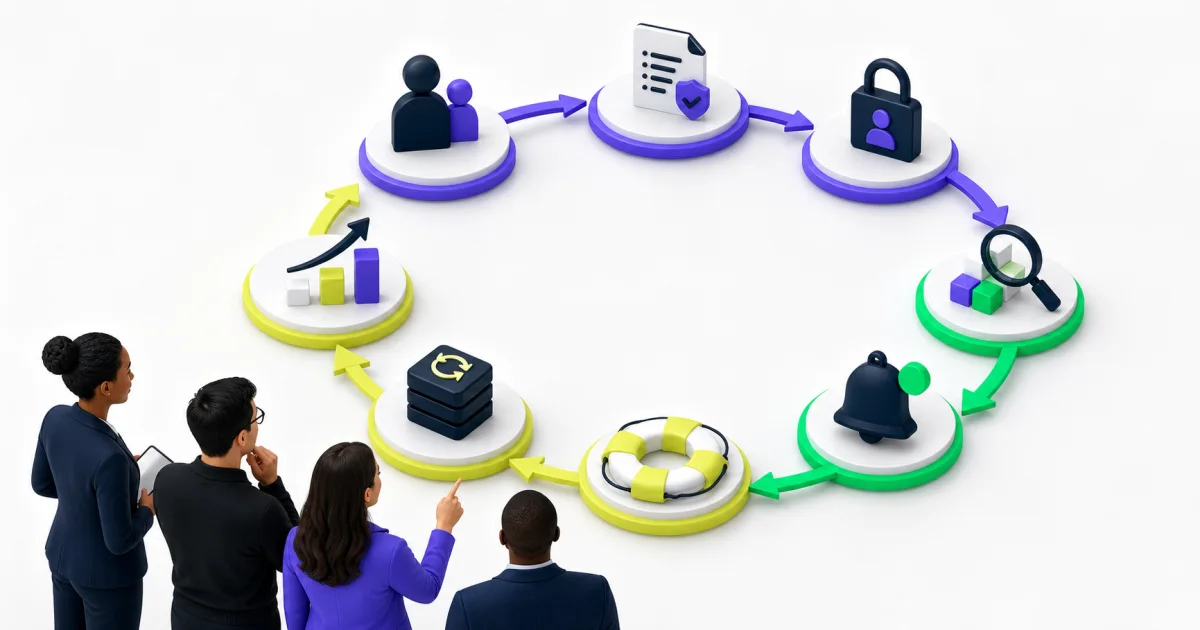
A Practical Delivery Sequence
1. Discover
Map business events, current transfers, manual work, errors, and dependencies. Identify the people who own each outcome.
2. Design
Choose the source for each field, integration pattern, security model, data contract, service target, and recovery approach.
3. Build and Test
Configure mappings and controls, then test standard paths, exceptions, security, reconciliation, and recovery with business owners.
4. Launch
Deploy through change control, confirm monitoring and support readiness, communicate impacts, and observe the first production cycles closely.
5. Stabilize
Resolve early defects, tune alerts, document recurring exceptions, and confirm that ownership works in practice.
6. Improve
Review service measures and business outcomes. Simplify mappings, remove unused flows, automate repeatable recovery, and update documentation.
Common Failure Modes
Integration programs often struggle because teams:
- Automate a process before clarifying ownership
- Treat one application as authoritative for every field
- Build without a documented data contract
- Test only successful examples
- Monitor transport but not business completeness
- Send alerts without assigning resolution ownership
- Use personal accounts for production connections
- Ignore downstream effects of effective-dated changes
- Count projected savings without measuring the baseline
- Depend on a specialist without transferring operational knowledge
Most of these problems come from operating-model gaps rather than the integration technology itself.
HR Technology Integrations FAQs
Who should own an HR integration?
A business owner should own the outcome, data meaning, and priority. A technical owner should own design, monitoring, deployment, and recovery. Critical flows also need named security, privacy, payroll, or vendor participants.
When is an API better than a file?
Use an API when the process benefits from direct requests, frequent updates, or event-driven behavior and both platforms support the required objects and controls. Use a scheduled file when the exchange is batch-oriented, the receiving system requires it, or the operating model can manage the timing and reconciliation reliably.
How should teams monitor an integration?
Monitor connection health, authentication, volume, timing, accepted and rejected records, retries, duplicates, and source-to-target reconciliation. Assign every exception to a support process with severity, response expectations, and escalation.
How do you calculate integration ROI?
Compare measured improvements in effort, errors, cycle time, support demand, data availability, and operational risk with the full design, platform, testing, support, and change cost. Use the organization's baseline rather than a generic percentage.
Build Connections the Organization Can Operate
Reliable HR technology integrations combine sound technical design with business ownership, governed data, security, realistic testing, monitoring, and recovery. That operating discipline keeps a data flow useful after the implementation team leaves and the surrounding systems continue to change.
Start with one consequential business event, document the full path, and make ownership visible before selecting the integration method. If you need help designing, implementing, or stabilizing connected HR systems, EVOCS can support the work through HR integration architecture and ongoing managed services.
Sources: NIST Cybersecurity Framework 2.0, NIST SP 800-207 Zero Trust Architecture, and OWASP API Security Top 10.